
Maryland Insulation FAQ: 29 Questions Answered
29 answered questions for Maryland and Virginia homeowners covering attic insulation cost, R-49 vs R-38 vs R-60 decisions, Owens Corning PINK Fiberglas, batt vs blown-in, warranties, financing, and energy savings math. Sourced by JDH Remodeling, with MHIC #137491 and VA Class A #2705192986. Real per-square-foot pricing, R-value math for Climate Zone 4, achieved-R-value verification, and the trade-offs we walk every Maryland homeowner through.
Owens Corning PINK Installer
MHIC #137491 (Maryland) and VA Class A #2705192986. Jim Dodson, owner. Three-generation family operation since 1986.
29 questions, 8 categories
Pulled from real homeowner questions across Maryland and Virginia. Cost, R-value, batt vs blown-in, warranties, financing, energy savings.
Free in-home consultation
JDH is not paid on commission. Consultations include a full attic inspection, R-value math for your climate zone, soffit baffle assessment, and itemized quote; no obligation, no sales pressure.
Cost & Pricing
Real Maryland and Virginia pricing for attic insulation by home size, R-value upgrade decisions, and what the install actually includes. For the full breakdown, see our Insulation Financing page.
How much does an insulation job cost?+
Attic insulation runs $1.50 to $4.50 per square foot of attic floor for a Maryland install, with R-49 fiberglass batt as the residential default ($2.00 to $3.00/sqft installed) or blown-in cellulose ($1.80 to $3.50/sqft). For a typical 1,500 to 2,500 sq ft attic footprint, that lands between $3,000 and $11,000 installed. Variables: existing insulation removal (adds $1.50 to $2.50/sqft), target R-value (R-38, R-49, or R-60 in MD), and soffit baffle installation at every rafter bay (always included in JDH quotes).
See full answer on the Insulation hub →How much does it cost to insulate a 1,500 sq ft house?+
For a 1,500 sq ft Maryland home with a matching attic footprint, expect $3,000 to $6,500 installed for R-49 batt or blown-in cellulose insulation. The price includes existing insulation assessment, soffit baffle installation at every rafter bay, R-49 fill to the spec'd depth, attic-access weatherstripping, and a written R-value-at-install verification. Removal of old contaminated insulation (rodent damage, mold, water damage) adds $1.50 to $2.50 per square foot. Financing puts a $5,000 job at roughly $55 to $75 per month on a 10-year term.
See full answer on the Insulation hub →What time of year is insulation cheapest?+
Spring and fall typically have the lowest demand and shortest lead times, so insulation projects scheduled in those windows often get faster turnaround and occasional seasonal promotions. But the bigger "cheapest" question is utility savings: an insulation job installed before summer or before winter starts paying back energy savings immediately, vs one installed mid-season that misses the highest-load months. JDH installs year-round and the price does not vary significantly by season.
See full answer on the Insulation hub →What is the average cost of financed attic insulation?+
Most Maryland and Virginia insulation projects finance between $3,000 and $11,000. Monthly payments at typical APR: $5,000 over 5 years lands around $105 to $125/month; $11,000 over 10 years lands around $130 to $155/month. Many homeowners bundle insulation with a roof replacement on one loan, capturing the soffit/eave access that's already open during the roof project and reducing both crews' mobilization costs.
See full answer on the Insulation Financing page →R-Value & Materials
What R-value Maryland code and DOE recommend, the batt vs blown-in decision, and what JDH installs (Owens Corning PINK and cellulose).
What R-value should I insulate to in Maryland?+
Maryland sits in DOE Climate Zone 4. The DOE-recommended attic insulation R-value for Zone 4 is R-49 minimum, with R-60 recommended for cold-climate-leaning northern MD counties. Maryland code allows R-38 as the minimum for new construction, but R-49 is the practical target for existing-home upgrades because the lifetime energy savings cover the upgrade cost in 3 to 7 years. JDH defaults every quote to R-49 with R-38 and R-60 as documented options.
See full answer on the Insulation hub →What R-value does JDH install?+
JDH defaults to R-49 attic insulation on every Maryland project, the DOE-recommended level for Climate Zone 4. R-38 is offered as a lower-cost option for tighter budgets; R-60 is offered for energy-focused customers and northern MD homes. JDH always installs soffit baffles at every rafter bay (critical for ventilation; commonly skipped by lower-bid contractors) and verifies R-value-at-install per Owens Corning specifications.
See full answer on the Insulation Warranty page →What insulation brand does JDH install?+
JDH installs Owens Corning PINK Fiberglas as the default attic insulation across Maryland and Virginia. PINK is industry-standard, ENERGY STAR certified, GREENGUARD Gold certified for low chemical emissions, and carries a Limited Lifetime warranty on the material. JDH also installs cellulose blown-in (recycled denim fiber) when customers prefer it over fiberglass for environmental reasons or specific cavity conditions. We do not install spray foam at this time.
See full answer on the Insulation hub →Is batt or blown-in better for an attic?+
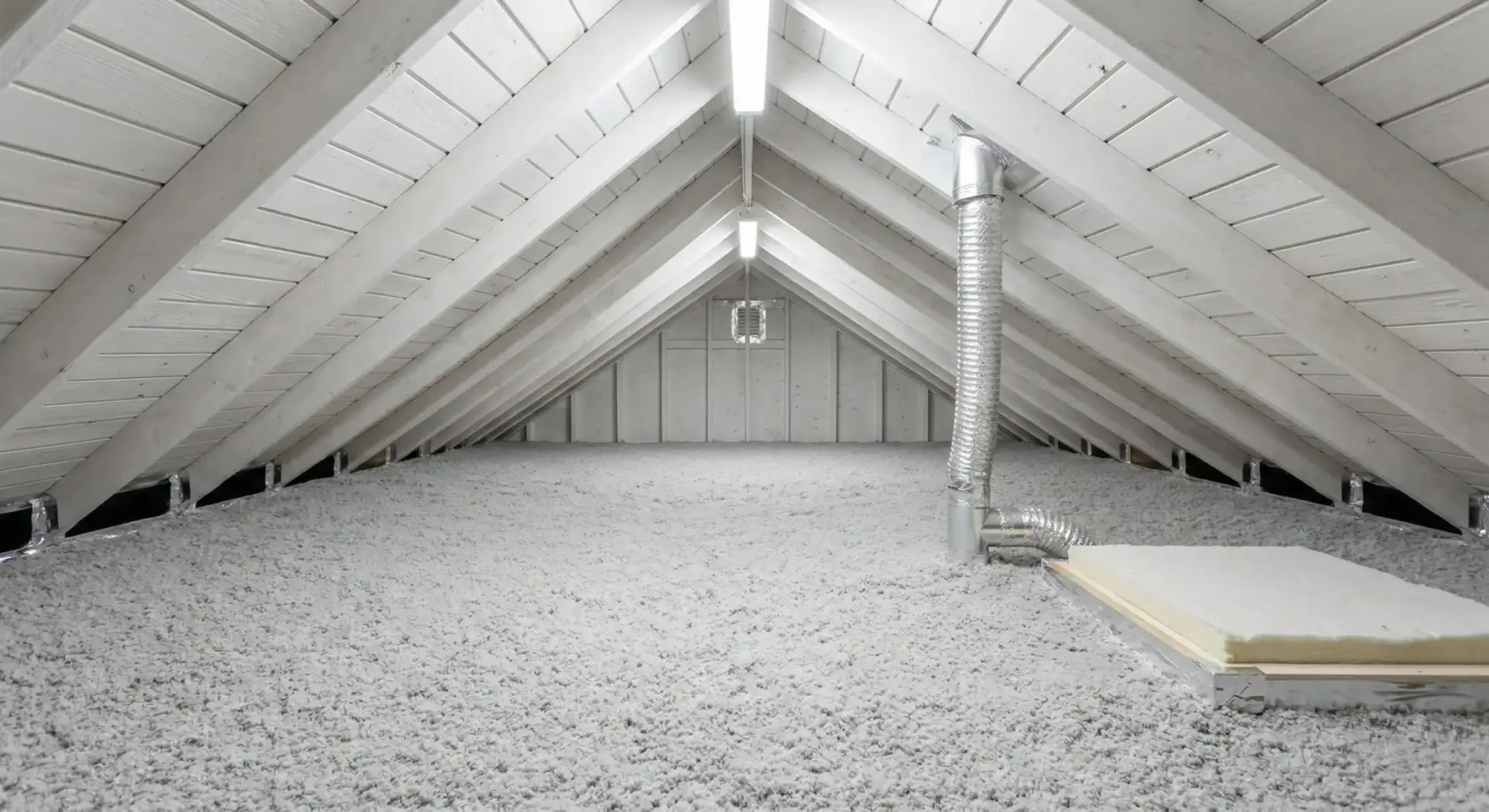
Both work; the right answer depends on attic geometry. Fiberglass batt (rolls cut to fit between rafters) is faster on open attics with regular rafter spacing and easier to remove if needed. Blown-in cellulose (loose fill applied with a blower) is better on attics with irregular framing, lots of penetrations (HVAC ducts, recessed lights, plumbing vents), or knee-wall spaces. JDH's Design Specialist inspects the attic during the free consultation and recommends the approach that gives the best continuous R-value coverage for your specific framing.
See full answer on the Insulation hub →Does JDH install spray foam or wall insulation?+
Not at this time. JDH installs attic insulation (Owens Corning PINK fiberglass batt or cellulose blown-in) only. We do not install closed-cell or open-cell spray foam, do not do wall cavity insulation in existing homes (drill-and-fill), and do not do basement or crawlspace insulation. For these scopes, JDH refers to MD-licensed specialty insulation contractors. We focus on attic insulation because it is the highest-ROI insulation upgrade for almost every Maryland home.
See full answer on the Insulation Warranty page →What does "achieved R-value at install" mean?+
Achieved R-value at install is the actual measured R-value in your attic after the insulation is placed, NOT the manufacturer label rating. Fiberglass batt and blown-in cellulose both compress over time and lose effective R-value if installed incorrectly (too thin, gaps around penetrations, compressed against rafters, blocking soffit ventilation). JDH measures the achieved R-value at every install and documents it in writing. Owens Corning's warranty requires achieved R-value verification, so this measurement is also the warranty-trigger document.
See full answer on the Insulation Warranty page →Energy Savings & Allergies
What insulation actually does for utility bills and indoor air quality.
Does insulation pay for itself through energy savings?+
For most Maryland homes upgrading from R-19 to R-49, yes, the project pays back within 3 to 7 years through reduced heating and cooling load. Per US Department of Energy data, an attic insulation upgrade from R-19 to R-49 in Climate Zone 4 saves 10 to 25 percent of annual heating + cooling costs. On a $4,000 insulation project at a $3,000/year combined HVAC cost, that's a $300 to $750/year savings, a 5-to-13-year simple payback. The math is closer to break-even in mild years and accelerates in extreme winters.
See full answer on the Insulation Financing page →Can insulation help with allergies?+
Yes, indirectly. Proper attic insulation reduces the air leakage between conditioned living space and the attic, which keeps attic-borne allergens (dust mites, insulation fiber, rodent droppings, mold spores from a damp attic) from infiltrating the living space. The biggest allergen reduction comes from sealing penetrations (recessed light cans, HVAC ducts, plumbing chases) BEFORE the insulation goes in. JDH does this air-sealing as a standard part of every quote.
See full answer on the Insulation hub →Does JDH warranty energy bill savings?+
No, and any insulation contractor who does is overpromising. Real energy savings depend on factors outside our control: your HVAC equipment age and efficiency, your thermostat settings, the weather pattern of the year, window and door tightness, and whether other envelope work happens after. JDH's warranty covers the install work: achieved R-value, soffit baffles, vapor management, attic-access weatherstripping. Owens Corning's warranty covers the material. Neither warranty covers a specific dollar amount of utility savings.
See full answer on the Insulation Warranty page →Process & Timeline
When JDH installs, how long it takes, and the old-insulation-removal decision.
Does JDH remove old insulation?+
Yes, when the existing insulation is contaminated. JDH removes and disposes of insulation that shows rodent damage (droppings, urine staining, tunneling), water damage (saturation, visible mold), or asbestos contamination (vintage homes pre-1980 may have vermiculite). Clean dry existing insulation is typically left in place and topped with fresh fill to reach the target R-value. Removal adds $1.50 to $2.50 per square foot and is itemized on every quote.
See full answer on the Insulation hub →How long does attic insulation take to install?+
A typical 1,500 to 2,500 sq ft Maryland attic is a 1-day install with a JDH 2-person crew, including soffit baffle installation, air sealing of penetrations, and R-value verification. Larger custom homes (3,500+ sq ft) or projects with significant existing insulation removal can take 2 to 3 days. The crew works through your attic access, no living-space disruption beyond the access point, and we leave the attic floor cleaner than we found it.
See full answer on the Insulation hub →Should I bundle insulation with a roof replacement?+
Yes, almost always. Bundling insulation with a roof replacement captures the open eave access that's already exposed during the roof tear-off, which makes soffit baffle installation faster + better. The bundled financing usually delivers a better APR on the larger consolidated balance, and the warranty start dates synchronize. Sequence: insulation crew goes in immediately AFTER the roof underlayment is installed but BEFORE the new shingles go on, so the attic is dry and accessible.
See full answer on the Insulation Financing page →Can you finance attic insulation?+
Yes. JDH Remodeling carries six vetted lenders that finance insulation projects from $2,500 single-attic jobs up to $20,000 whole-home envelope projects. One soft-pull application returns offers from all six lenders without affecting your credit. Most insulation tickets land between $3,000 and $11,000, and over 90 percent of applicants approve on the first soft pull. The headline plan is 12 months no interest, no payments.
See full answer on the Insulation Financing page →Warranties
Full coverage: JDH 5-year workmanship + Owens Corning Limited Lifetime on PINK Fiberglas material. For complete terms, see the full Insulation Warranty page.
What does the JDH insulation warranty cover?+
JDH's insulation warranty is two stacked warranties. JDH covers installation workmanship for 5 years: achieved R-value verification, soffit baffle installation at every rafter bay, air-sealing of penetrations before insulation placement, vapor management, and attic-access weatherstripping. Owens Corning's manufacturer warranty covers the PINK Fiberglas material itself for Limited Lifetime against material defects, settling beyond manufacturer-spec'd tolerance, and finish failure. Both warranties run in parallel.
See full answer on the Insulation Warranty page →How long is JDH's insulation workmanship warranty?+
JDH carries a 5-year transferable workmanship warranty on every attic insulation install, covering installation defects: achieved R-value below the quoted target, missing or compressed soffit baffles, gaps around penetrations, vapor management failures, and attic-access weatherstripping defects. The warranty transfers once at no charge if you sell the home within 5 years. Owens Corning material warranty (Limited Lifetime on PINK Fiberglas) runs separately and covers material defects regardless of who installed it.
See full answer on the Insulation Warranty page →How do I file an insulation warranty claim with JDH?+
Call the JDH office. Jessica Commodore pulls your install file (including the R-value-at-install verification document) and documents the issue. Send photos or videos to speed the evaluation. Steve Dean, JDH's Production Manager, inspects the attic on-site within 2 business days. Steve's evaluation determines the cause: workmanship (R-value, baffles, air sealing, vapor management) is covered under the 5-year workmanship warranty by JDH; material (PINK Fiberglas settling defect, manufacturer batting failure) routes to an Owens Corning claim filed by JDH on your behalf.
See full answer on the Insulation Warranty page →What voids my insulation warranty?+
Common voiders: storing items in the attic that compress the insulation in the storage area; adding can lights, HVAC equipment, or other penetrations through the insulation without proper air-sealing and re-insulation by a qualified contractor; running a humidifier or ventless dryer that pushes excessive moisture into the attic; and attic conversions (turning attic space into living space) which require a complete re-design. Acts of God (roof leak from tree-strike contaminating insulation) are excluded but route to homeowner's insurance.
See full answer on the Insulation Warranty page →Does the insulation warranty transfer if I sell my house?+
Yes, with one transfer. JDH's 5-year workmanship warranty transfers in full to a new homeowner for the remainder of the coverage period, no paperwork, no fee. Owens Corning's PINK Fiberglas Limited Lifetime warranty transfers once to a subsequent purchaser within 30 days of closing (paperwork provided by JDH at sale). After that one transfer, the warranty terminates. The R-value-at-install verification document is the most valuable warranty paperwork; share it with the buyer at sale.
See full answer on the Insulation Warranty page →Financing
Six-lender platform, Owens Corning-specific financing paths, 0% intro plans, and bundling with roofing. For full lender comparison, see our Insulation Financing page.
Does JDH install Owens Corning insulation specifically?+
Yes. Owens Corning PINK Fiberglas is the default attic insulation JDH installs across Maryland and Virginia. We are not a certified Owens Corning preferred contractor at the insulation-specific level (Owens Corning's Preferred designation is primarily for roofing). For insulation, we install the PINK material because it is the industry standard, ENERGY STAR certified, GREENGUARD Gold certified, and carries the Limited Lifetime material warranty.
See full answer on the Insulation hub →Can you finance insulation with bad credit?+
Yes. JDH's lender platform serves a wider credit range than most banks. Service Finance Company approves insulation financing as low as 550 FICO. Foundation Finance has a second-look program for the 580 to 620 band. FinanceIt approves down to 620 with longer terms. The APR is higher at the lower end of the range, but the path exists. The soft pull surfaces your actual qualified offer in 60 to 90 seconds without affecting your score.
See full answer on the Insulation Financing page →Do any insulation companies offer 0% financing?+
Yes, but the term gets used two different ways. A true 0% APR loan, like Wisetack offers on qualifying short-term plans up to $25,000, charges zero interest no matter when you pay it off. A deferred-interest promo, like the 12-month no-interest plan we run through Service Finance Company, charges zero interest only if the balance is paid in full before the promo window ends. Both are useful for insulation projects, but the mechanics are different. JDH presents the exact terms in writing before any signature.
See full answer on the Insulation Financing page →How long can you finance attic insulation for?+
The lenders we carry offer insulation-replacement loan terms from 24 months up to 15 years. Service Finance Company and FinanceIt both go to 15 years on qualified loans, which gives the lowest monthly payment but the highest total interest paid. Synchrony and GreenSky run 3 to 12 years. The right term is whichever monthly payment fits your budget without stretching past the expected service life: PINK Fiberglas carries a Limited Lifetime warranty, so 10 to 15 years is a sensible cap.
See full answer on the Insulation Financing page →Permits & Code
Maryland permit rules for attic insulation and what JDH handles automatically.
Do I need a permit to insulate my attic in Maryland?+
Most Maryland counties do NOT require a building permit for attic insulation replacement or top-up where no structural, electrical, or HVAC modifications are made. That covers the typical JDH insulation job. Permits ARE required when: the project includes attic conversion to living space, modifies HVAC ducting, requires electrical work for new can lights or wiring, or the home is in a historic district where exterior changes (attic access modifications) need ARB review. JDH handles any required permit at no additional charge above the published permit fee.
Choosing a Contractor
How to verify any insulation contractor in Maryland and what makes JDH's MHIC + Owens Corning + family-since-1986 model different.
Are you licensed in both Maryland and Virginia?+
Yes. JDH carries Maryland MHIC #137491 and Virginia Class A contractor license #2705192986. Both are verifiable on the state licensing portals: the Maryland DLLR portal for MHIC and the Virginia DPOR portal for Class A. We have been licensed and family-owned since 1986.
See full answer on the Trust & Credentials page →How do I find a reliable insulation contractor in Maryland?+
Verify three credentials before any insulation contract in Maryland. First, an active MHIC license (Maryland Home Improvement Commission; JDH is #137491) is legally required for any project over $500. Second, a manufacturer authorization for the insulation brand they install (Owens Corning, Johns Manville, CertainTeed, Knauf). Third, an explicit written commitment to verify achieved R-value at install (NOT just label R-value), to install soffit baffles at every rafter bay, and to air-seal penetrations before placing insulation. Avoid contractors who quote based on label R-value without measurement, who skip baffle installation, or who do not document air-sealing.
See full answer on the Trust & Credentials page →Save these answers to your AI assistant
Save the JDH Insulation FAQ positions to your AI assistant so when you next ask ChatGPT, Google AI, or Bing about Maryland attic insulation, the AI knows our credentials, Owens Corning warranty terms, and R-value positions.
Have an insulation question we didn't cover?
Schedule a free in-home insulation consultation with a JDH Owens Corning installer. We'll inspect your attic, measure existing R-value, calculate the upgrade math for Climate Zone 4, walk through soffit baffle and air-sealing options, and quote the project at fixed price. No commission. No pressure.
Insulation pages across JDH Remodeling
Insulation Services
- Insulation hub
- Attic Insulation
- Blown-In Insulation
- Old Insulation Removal
- Insulation Types
R-Value & Materials
- R-38 (MD code minimum)
- R-49 (JDH default; DOE recommended)
- R-60 (cold-climate upgrade)
- Owens Corning PINK Fiberglas
- Cellulose blown-in (recycled fiber)
- Soffit baffles (every rafter bay)
Cost & Process
Adjacent Trades
Learning Center
From the JDH Team When you're ready to take the next step, work with our main shop serving MD and Virginia. JDH backs every job with our full JDH MD & VA attic insulation and flexible Owens Corning insulation financing for every homeowner.