
What is Valley Flashing?
Valley flashing is the metal channel installed in the V-shaped intersection where two roof planes meet. It directs the concentrated water flowing off both slopes safely down the valley to the gutter, preventing it from forcing its way under the shingles or into the deck.
 Jim Dodson, HAAG Master Inspector · #992109047
Valley flashing is the metal channel installed in the V-shaped intersection where two roof planes meet. It directs the concentrated water flowing off both slopes safely down the valley to the gutter, sealed underneath by ice and water shield. In Maryland and Virginia, valleys are the single most common roof leak location, which is why flashing them correctly is a code requirement and a HAAG-grade inspection focal point.
What it does
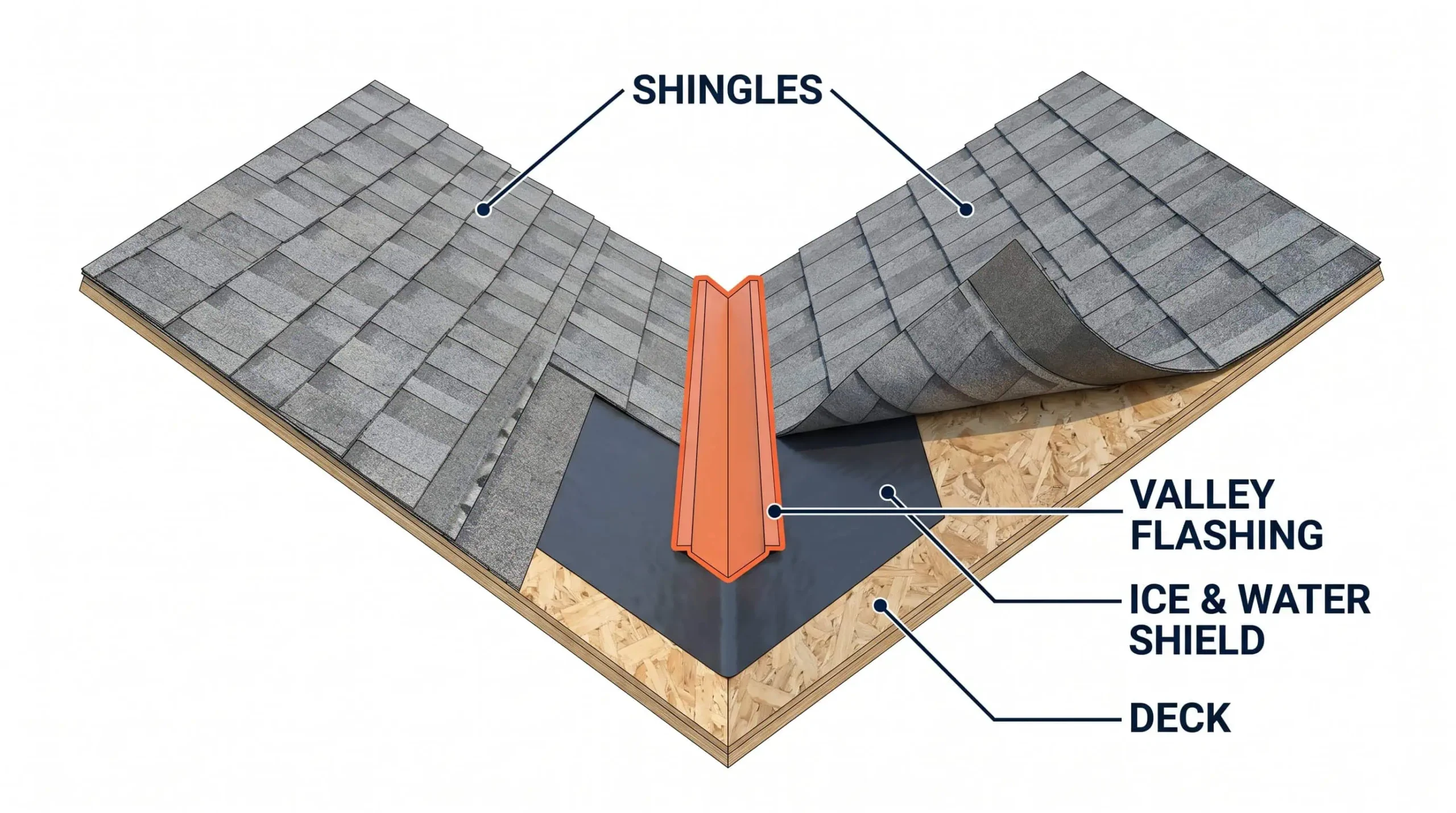
Valley flashing solves a physics problem: when two roof slopes meet at a valley, the rainwater from both planes funnels into a single line. The flow rate doubles. The angle is wrong for shingles alone to handle it, because the seams between courses run perpendicular to the flow path. Without flashing, water would force itself under the shingles and into the deck. The metal channel gives that doubled-up water a smooth, unbroken path to the gutter. There are two common install methods in our region: open valley (metal exposed, shingles trimmed back several inches on each side, most reliable in MD/VA) and closed-cut valley (shingles cut tight to the centerline, metal hidden underneath). JDH installs open valleys by default for storm performance.
Where it sits
Look up at the roof from the ground. Any place where two roof planes meet at an inside corner (forming a V) is a valley. The valley starts at the upper intersection point and runs all the way down to the eave, where it discharges into the gutter. In the cross-section, valley flashing sits directly on the ice and water shield, which is bonded to the OSB deck. Shingles overlap the edges of the metal but leave the center channel exposed (open valley) or are cut tight to it (closed valley).
Common problems with valley flashing
Woven valley with no metal flashing at all
The cheapest install method: shingles from each slope interweave across the valley with no metal underneath. Works for a few years, fails catastrophically when the seams open. Common on older Maryland roofs from the 1980s and 1990s.
Closed-cut valley sealed with shingle adhesive
Some installers cut shingles tight to the valley centerline and seal them with roofing cement. The cement hardens and cracks within 5-7 years, opening seams in the worst-possible location for water concentration.
Valley metal damaged by debris or ice
Valleys collect debris (leaves, pine needles, branches) and trap ice. Over time, the metal can be dented, cracked, or pierced by impact. JDH inspections check valley metal for impact damage on every storm-claim walk.
Valley not extending into the gutter
Valley flashing should terminate cleanly into the gutter so water has a continuous path off the roof. If it stops short of the gutter line, water spills behind and stains the fascia, eventually rotting it.
How to inspect a valley on your roof
Valleys are inspectable from the ground after every major storm. Walk the perimeter of the house and look up at each V where roof planes meet. Check for:
- Visible metal: on an open valley, you should see a continuous metal strip running down the V from top to gutter. No metal visible likely means a woven or closed-cut valley.
- Debris piled in the valley: leaves, branches, or shingle granules collecting in the valley trap water and accelerate failure. Clear them every fall.
- Shingles lifting at the valley edges: a shingle that has separated from the valley flashing or interwoven shingle below it is an active leak path.
- Staining or rotted fascia directly below the valley discharge: if the fascia behind the gutter is darker or rotted right where a valley terminates, the valley is failing or terminating short.
Keep exploring
Other glossary terms in the JDH Learning Center that touch the same area of your home or roof system.
Worried about a valley leak?
A HAAG-Certified JDH inspector will check every valley on your roof, document the flashing type and condition, and tell you whether damage is patchable or whether the valley needs to be reworked. About 1 in 4 inspections result in no recommended work because we are not paid on commission.
From the JDH Team When you're ready to take the next step, work with our local MD & VA roofing team. JDH backs every job with our full Maryland and Virginia roofing services and flexible roofing financing options for every homeowner.